Bearded Dragon vs Leopard Gecko: Which Lizard Actually Fits Your Life?
Disclosure: PawCritic is reader-supported. A couple of links below are Amazon affiliate links, and we may earn a small commission if you buy through them — it costs you nothing extra.
Every pet store on earth stocks these two lizards, which means every new reptile keeper on earth picks between them. And most pick wrong — not because either is a bad animal, but because they chose the one that looked cooler in the window instead of the one that matches how they actually live.
I've kept both. A bearded dragon named Fig who was basically a scaly golden retriever — ran to the front of the enclosure when I came home, ate from my hand, demanded to be held. And a leopard gecko named Moth who tolerated me twice a week, was occasionally visible, and needed almost nothing from me except warmth and the occasional cricket delivery. Both are wonderful. They are not the same commitment.
Here's the honest breakdown, built around the questions that actually decide whether either of these animals works in your home.
Quick Comparison
| Bearded Dragon | Leopard Gecko | |
|---|---|---|
| Adult size | 18–24 in, 400–600 g | 7–10 in, 50–80 g |
| Lifespan | 10–15 years | 15–20 years |
| Daily care time | 45–90 minutes | 15–30 minutes |
| Enclosure (adult) | 4×2×2 ft (120 gal) | 36×18×18 in (20 gal long) |
| Lighting | Strong UVB + basking heat | Moderate UVB (low-output) + under-tank heat |
| Diet | 80% veg / 20% insects (adult) | 100% insects |
| Daily greens prep | Yes, every single day | No |
| Live insects | Daily as juveniles, weekly as adults | Every 2–3 days |
| Handling | Loves it — a true lap lizard | Tolerates it; nocturnal, often sleepy |
| Interactivity | Diurnal, active during the day | Nocturnal, awake in the evening |
| Setup cost | $400–900 | $200–450 |
| Annual upkeep | $150–300 | $100–200 |
| Best for | People home during the day, want an interactive pet | Busy people, quiet households, smaller budgets |
Time: The Difference Nobody Mentions
Here's the thing nobody tells you at the pet store: a bearded dragon is a daily chore with a face. Not because it's hard — it isn't — but because it's daily and it's every day, forever, for a decade plus.
A beardie needs fresh greens chopped and offered every morning, a salad bowl cleaned out nightly, live insects as a juvenile (daily) and as an adult (a few times a week), a water bowl, spot cleaning, temperature checks, UVB tube replacement every 12 months on schedule, and a weekly full enclosure wipe-down. Miss a few days of fresh greens and the animal doesn't die — but the pattern is what matters: there is no skip button. It's the closest thing to a dog that a lizard can be.
A leopard gecko, by contrast, is a low-maintenance setup that mostly maintains itself. Feed 5–8 appropriately-sized insects every 2–3 days. Fresh water. Spot clean once a week. Change substrate a couple of times a year. Check temps weekly. That's genuinely most of the job. Geckos thrive on benign neglect in a way beardies never will.
If your life involves unpredictable hours, travel, or a household where "who's feeding the pet" is a recurring fight — the gecko is the honest answer. A beardie left unfed for a weekend is fine; a beardie ignored for a week is in real trouble.
Space and Setup Costs
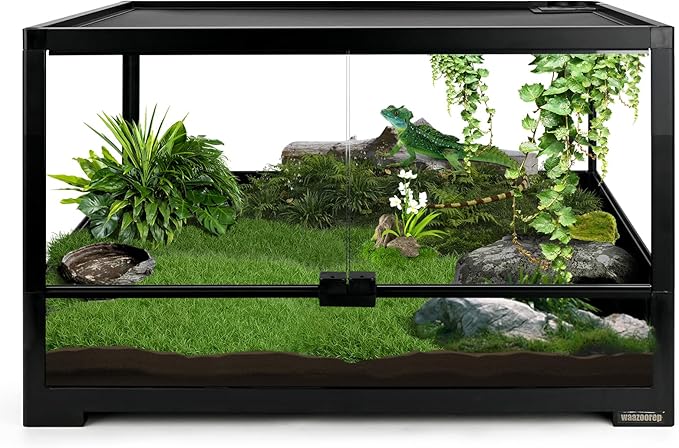
An adult bearded dragon needs a 4×2×2 foot enclosure — that's 120 gallons of space that has to live in your house and be kept at the right temperatures. It's a piece of furniture. A good one costs $300–500 alone, and the full setup (enclosure, T5 UVB, halogens, thermostat, substrate, furnishings) lands between $400 and $900 depending on how much you DIY.
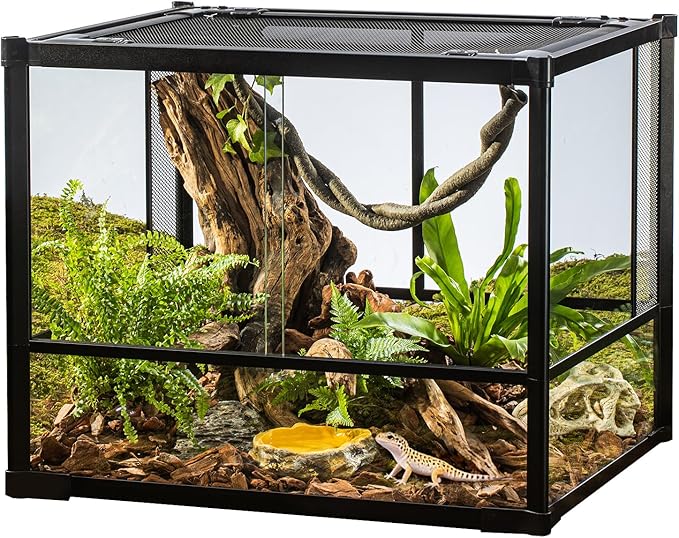
A leopard gecko's adult home is a 36×18×18 inch enclosure — a 20-gallon long. You can set one up properly for $200–450, and it fits on a dresser or a deep shelf. Total footprint is less than half the beardie's, and the electrical draw is smaller too: geckos use an under-tank heat mat or low-wattage bulb, not the sun-simulating rig a beardie demands.
The beardie's UVB setup is non-negotiable and it's the priciest recurring cost. A proper T5 HO UVB fixture kit runs $70–120, and the tube must be replaced every 12 months — the UVB mistakes guide explains why, and it's worth reading before you buy either lizard. Geckos can get by with a lower-output UVB, and a healthy adult can even go without on a gut-loaded, supplemented insect diet — though I'd still provide low-level UVB, because the evidence increasingly says it matters for their long-term bone health.
Diet: Bugs Every Day vs Bugs Every Other Day
Feeding is where these two diverge hardest.
Bearded dragons are omnivores. Adults are roughly 80% vegetables and 20% insects; juveniles are the reverse and need live insects daily — often 50–80 small roaches or crickets a day, every day, for the first year. That's a bug budget of $30–60 a month for a baby beardie and a daily salad prep routine that never stops. The vegetables must be the right ones (dark leafy greens, squash, bell pepper — no spinach or kale as staples), dusted with calcium five days a week and a multivitamin twice a week.
Feeding a beardie is a genuine daily ritual. Feeding it wrong — too many bugs, the wrong greens, no calcium — is how you get metabolic bone disease, fatty liver, and obesity, which are the three big killers of captive beardies.
Leopard geckos are insectivores. That's it. Crickets, dubia roaches, mealworms, and the occasional waxworm as a treat, every 2–3 days as adults, dusted with calcium most feedings. No salad. No prep. No "what vegetables are safe today." If you find live insects gross, neither lizard is for you — but the gecko at least minimizes the exposure.
One honest note on bugs: you'll need a small cricket colony or a reliable local pet store, because "ran out of crickets on Sunday" is a real problem for both species. For the gecko it's a missed meal; for a juvenile beardie it's a skipped feeding on a day it needed one.
Handling and Interactivity: Lap Lizard vs Night Owl
This is the one that surprises people, because the gecko looks friendlier — all those big eyes and the famous smile. But here's the reality.
Bearded dragons are diurnal — awake during the day, exactly when you are. They're naturally curious, they sit on your shoulder while you watch TV, they'll fall asleep on your chest. They're one of the few reptiles that genuinely seek out interaction. Fig used to scratch at the glass when I walked past without picking him up. I've owned dogs less needy than that.
Leopard geckos are nocturnal. During the day, when most people want to handle a pet, they're sleeping in their hides — and waking them to handle them is exactly as popular with the gecko as you'd expect. They're at their most active from 8 PM onward. A gecko will sit in your hand calmly, but it's a tolerate-and-warm-your-palm experience, not an interactive one. You're the warm branch, not the best friend.
Neither lizard is cuddly in the mammal sense. Both are fine with handling if you're gentle and regular. But if your fantasy is an animal that comes to the glass when you get home, that's the beardie, and it's not close.
Which One Gets Sick Less?
Statistically? The leopard gecko. Beardies have a reputation for health problems that is honestly earned — a lot of it comes from bad captive breeding and from owners who can't keep up with the UVB-and-salad routine, but a lot of it is also just the species. They're prone to metabolic bone disease, fatty liver, respiratory infections, and reproductive issues in females. The Association of Reptilian and Amphibian Veterinarians has published extensively on how captive lizard health — MBD especially — traces back to husbandry: lighting, diet, and calcium-to-phosphorus balance.
Leopard geckos are genuinely hardy. Their classic issue is retained shed on toes and tail, which is a humidity problem (fix: a humid hide, always), and impaction from improper substrate (fix: don't use loose sand). Female geckos can also have egg-binding issues. That's the list. It's a short list.
Both need an exotics-experienced vet, and you should find one before you need one. Exotics vets are a finite resource; the search takes longer than people expect.
Night Heat and Temperature Requirements
Both are ectotherms — you supply the warmth, or they get sick. The difference is in the equipment.
A beardie needs a basking surface of 95–105°F with a cool side around 75–80°F, a strong T5 UVB tube running the length of the warm side, and a thermostat so the halogen doesn't cook anything. You're building a small sun. The setup is more gear, more money, and more things to check — but the behavior payoff is an animal that's visibly alive and engaged during your waking hours.
A leopard gecko needs a warm side around 88–92°F (measured at the floor, where they live), a cool side in the mid-70s, and low-output UVB if you provide it. An under-tank heat mat on a thermostat, or a low-wattage overhead bulb, does the job. Far simpler, far cheaper to run, and — honest advantage for a gecko — the temperature targets are easier to hit consistently in a small enclosure.
Whatever you pick, get a real thermostat. The Inkbird ITC-308 is the standard people land on for both heat mats and bulbs, and it's cheap insurance against a 1 AM heater failure. Our reptile thermostat guide covers dimming vs on/off units and what each species actually needs.
Kids and Household Fit
For a household with younger kids, my honest recommendation is the beardie — with supervision. Here's why: a leopard gecko's tail drops off when it's grabbed or frightened. It's a defense mechanism, it's stressful for the animal, and the regrown tail is never the same. Kids grab. That's what kids do. A beardie is sturdy, doesn't drop parts of itself, and tolerates the kind of gentle handling a supervised 8-year-old can learn. The tail-drop thing alone has rehomed a lot of geckos from households with small children.
Conversely, for a household with no kids, a busy adult schedule, or limited space, the gecko is the more honest choice — less daily obligation, smaller footprint, lower ongoing cost.
So Which One Should You Get?
Get a bearded dragon if: you're home during the day, you want an interactive pet that actually reacts to you, you can commit to a daily salad-and-bugs routine for 10–15 years, you have room for a 4-foot enclosure, and you can handle the upfront cost.
Get a leopard gecko if: you're out of the house a lot, you want a low-maintenance, long-lived pet, you have modest space and budget, you're a night owl, or you want a reptile that's genuinely forgiving while you learn.
Get neither if: you don't want to deal with live insects, you can't handle the decade-plus commitment, or nobody in the house will reliably do the daily chores. A lizard is not a plant, and the surrender rate for impulse-bought reptiles is brutal. If you're still weighing species generally, our guide to choosing a first pet reptile walks through the full decision.
My personal read: if you've never kept a reptile and you're not sure how deep you want to go, start with the gecko. It's cheaper, more forgiving, and it teaches you the fundamentals — temperature gradients, shedding, supplements — on a schedule that doesn't demand your attention daily. If you outgrow it, the beardie will still be there, and you'll be a much better keeper for having practiced on the easier animal first.
Related reading: How to Set Up a Bearded Dragon Enclosure: A Step-by-Step Build, Reptile UVB Lighting Mistakes & Safety Guide, Best Reptile Thermostats & Temperature Control, Reptile Myths Debunked: 12 Things New Owners Get Wrong and Bearded Dragon Food & Diet Supplies.