How to Set Up a Guinea Pig Cage: Step-by-Step for a Healthy, Happy Home
Disclosure: PawCritic is reader-supported. A couple of links below are Amazon affiliate links, and we may earn a small commission if you purchase through them at no extra cost to you.
Let me save you the mistake I made: I bought my first guinea pig "starter cage" from a pet store, and it was a cage meant for a hamster wearing a guinea pig costume. My piggie, a friendly Abyssinian named Mochi, couldn't run two full steps in any direction. She popcorned — the happy little jump guinea pigs do — exactly once, hit the wall, and stopped. That was the moment I measured the floor space and did the math. I'd spent $80 on a cage that was, by every welfare standard, unfit for her.
That experience is why this guide exists. The pet industry sells tiny cages because tiny cages fit on shelves and look cute. They're not suitable housing for a guinea pig, and the difference between an undersized cage and a properly sized one is the difference between a stressed, sickly pet and a happy, healthy one.
The good news: a proper guinea pig setup is not expensive, it's not complicated, and you can get it right on the first try. Here's the whole process, step by step.
Step 1: Get the Size Right — Before You Buy Anything
This is the non-negotiable foundation. Every other decision flows from the size of the cage, so this comes first.
The minimum recommended floor space for one guinea pig is 7.5 square feet (about 30" × 36", or 108 cm × 76 cm). For two guinea pigs — which is what you should have, because guinea pigs are herd animals and the Humane Society and ASPCA both recommend keeping them in pairs or groups — the minimum jumps to 10.5 square feet (about 30" × 50", or 76 cm × 127 cm).
Notice what I said: floor space. Levels and lofts are a bonus, but they don't count toward the minimum — guinea pigs are not climbers, and a fall from a loft can injure a guinea pig's delicate spine. The floor is where they live, and the floor has to be big enough.
Here's the trap: most commercial cages sold as "guinea pig cages" are 3-5 square feet. That's hamster territory. If the cage looks like it could fit in a shopping cart, it's too small for a guinea pig. The cages that meet the minimum are usually sold as "guinea pig cages" with the word "deluxe" or "large" in the name — or they're the modular cage systems made from connected wire grids (often called C&C cages, for cubes and coroplast). Those C&C-style setups are the community standard for good reason: they're affordable, customizable, and actually meet the floor space minimum. Our guide to the best guinea pig cages breaks down the specific models that measure up.
One more thing on size: bigger is always better. The minimum is a floor, not a target. A 12-square-foot cage for two pigs isn't overkill — it's the difference between pigs that thrive and pigs that merely survive. Guinea pigs need room to run, zoom, and popcorn, and they need it every day, not just at playtime.
Step 2: Choose the Bedding
Bedding is where new owners make their second mistake: buying the same wood shavings sold for hamsters. Cedar and pine shavings are genuinely bad for guinea pigs — they release aromatic phenols that irritate the respiratory tract, and guinea pig lungs are notoriously sensitive. Guinea pigs are prone to respiratory infections, and dusty, aromatic bedding is a direct contributor.
What works:
- Paper-based bedding (recycled paper pellets or fluff) — dust-free, absorbent, and safe. This is the most common recommendation from vets and the Humane Society.
- Aspen shavings — a safe wood option if you prefer shavings. No phenols, low dust.
- Fleece liners — washable fabric pads over an absorbent layer. Higher upfront cost, but cheaper long-term and popular with owners who don't mind laundry. They need daily spot-cleaning and weekly washing.
- Hay as a top layer — guinea pigs love burrowing in hay, and it's a natural enrichment layer over whatever base you choose.
What to avoid: cedar, pine, clay cat litter (toxic if eaten and it clumps into dangerous lumps), and any bedding with added fragrance or color. Our guinea pig bedding guide compares the safe options in detail.
How deep? Two to three inches, enough to absorb urine and let pigs root around. Spot-clean wet spots daily — a guinea pig cage that smells is a guinea pig cage that's been neglected. Full bedding changes once a week, or every 5-7 days for fleece.
Step 3: Set Up the Food and Water Stations
Guinea pigs have a unique dietary quirk you need to plan around: they cannot make their own vitamin C, exactly like humans. Scurvy is a real, documented disease in guinea pigs fed a poor diet. The ASPCA emphasizes that vitamin C is the single most important nutrient in a guinea pig's diet, and the cage setup has to support that.
The feeding stations:
- Hay — unlimited, always available. Timothy hay (or orchard grass for adults) should be 80% of the diet. A hay rack keeps it clean and off the bedding, or a hay pile in a corner works if your pig prefers to burrow. Never let the hay run out — guinea pigs need to graze constantly for dental health and digestion.
- Pellets — measured, not unlimited. About 1/8 cup per pig per day of a plain, high-quality pellet. Key word: plain. Avoid pellets with colored bits, seeds, dried fruit, or yogurt drops — those are junk food with a vitamin label. A plain timothy-based pellet is the boring-but-right choice; the boring ones are the ones without sugar and fillers. Use a heavy ceramic bowl that can't be tipped over.
- Vitamin C — daily. Fresh vegetables are the best source: bell peppers (red and green are both great), kale, and parsley are all high in vitamin C. A daily handful of veggies covers most of it, and a vitamin C supplement or drops can fill the gap if your pig is picky. If you want to understand the full diet, our guide to what guinea pigs can eat has the complete safe-foods list.
- Water — always full, always clean. A bottle or a bowl, your choice, but check it daily. Bottles leak and get clogged; bowls get dirty and tipped. Whichever you use, verify it's working every single day. A guinea pig without water for 24 hours is a guinea pig in trouble.
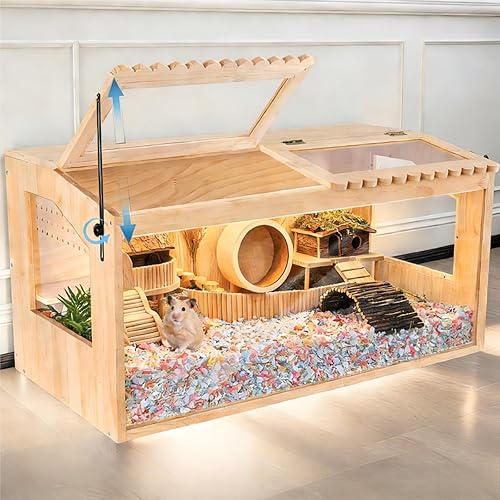
Put the food and water away from the litter area. Guinea pigs are tidy by nature — they pick a corner for the bathroom and keep the rest of the cage clean. Respecting that instinct makes your life easier.
Step 4: Add Hideouts — Non-Negotiable
A cage with food, water, and bedding but no hideout is a cage that will produce a terrified guinea pig. Guinea pigs are prey animals. Being out in the open, with no way to disappear, is a constant state of stress for them. The hideout is not decoration — it's the security system.
You need at least one hideout per pig, plus one extra if you want harmony. (Two pigs, three hideouts — the third prevents squabbles over the prime real estate.) Options:
- Store-bought wooden or fabric hideouts with two openings (two exits matter — a single exit turns a hideout into a trap if they're spooked).
- A simple cardboard box with holes cut in two sides — guinea pigs genuinely love these, and they're free.
- Fleece tunnels and cuddle cups for variety.
Place hideouts in different corners so each pig has its own territory. And here's a detail most guides skip: put a hideout near the food. Guinea pigs feel safest eating in cover, and a pig that has to eat in the open eats less.
Step 5: Location, Temperature, and the Environment
Where the cage lives matters as much as what's in it.
Temperature: Guinea pigs are cold-sensitive and heat-sensitive. The safe range is roughly 65-75°F (18-24°C). Below 60°F, they're at risk of hypothermia and respiratory infections — that's the number one killer in winter. Above 80°F, heat stress and heat stroke become real risks, and guinea pigs can't sweat. Keep the cage away from windows with direct sun, drafts, air conditioning vents, and heaters. If you're not sure the room stays in range, a small animal thermometer near the cage removes the guesswork — it's a $10 device that prevents two entirely preventable emergencies.
Noise and traffic: Guinea pigs are prey animals, and sudden loud noise terrifies them. A quiet corner of a living room can work — they're social and enjoy being near you — but a hallway, a laundry room, or next to a TV that's always on is not a home, it's a stress chamber. Find the balance: somewhere they're part of the household but not in the middle of it.
Other pets: If you have a dog or cat, the cage needs to be somewhere they can't reach, stare at, or stress the pigs through. A cat parked on top of the cage for hours is torture for a prey animal, even if the cat never touches them. Elevated placement or a room with a door that closes helps.
Step 6: The Daily and Weekly Routine
A setup isn't a one-time event — it's a maintenance schedule. Here's the routine that keeps a guinea pig cage healthy:
Daily (5 minutes):
- Spot-clean wet bedding and remove soiled hay
- Check the water bottle is full and flowing
- Refill hay — it should never be empty
- Fresh vegetables for vitamin C
- Quick visual check: both pigs active, eating, no discharge, no labored breathing
Weekly (20 minutes):
- Full bedding change and cage wipe-down (use a pet-safe cleaner; vinegar and water works)
- Wash and refill the water bottle
- Wash the food bowl
- Trim nails if needed (every 3-4 weeks usually)
Weekly health check: While you're cleaning, weigh your guinea pig. Weight loss is the earliest warning sign of illness in guinea pigs — they hide sickness, like most prey animals, but they can't hide a dropping number on the scale. A digital gram scale makes this a 30-second routine: weigh weekly, write it down, and if the number drops meaningfully, you know before symptoms appear. Most owners don't do this, and it's the single best early-warning tool you can own for the price of a pizza.
Daily floor time: The cage is the home base, but it's not the whole life. Guinea pigs need 1-2 hours of supervised floor time daily — running, exploring, popcorning. Set up a safe area (a playpen or a pig-proofed room with cords and wires out of reach — guinea pigs chew everything, including electrical cords), and let them burn energy. A guinea pig that never leaves the cage is a guinea pig that never fully lives.
Common Mistakes I See (and How to Avoid Them)
After years of watching new owners set up cages, these are the mistakes that come up over and over:
- The starter cage. Already covered, but it deserves the top spot. The pet store cage is a trap. Measure the floor space before you buy.
- One guinea pig. Guinea pigs are social animals; the Humane Society and most vets recommend pairs or groups. A solo pig is a lonely pig, and loneliness shortens their lives. If you can't commit to two, reconsider the pet entirely.
- Cedar or pine bedding. Respiratory damage, full stop. Paper or aspen only.
- Wire or mesh floors. Some cages come with wire grating floors "for cleanliness." Those floors cause bumblefoot — painful, infected sores on the feet — because guinea pig feet aren't built for walking on wire. Solid floors with bedding only.
- Wheels and balls. Exercise wheels are for hamsters. Guinea pigs are too heavy for them, and the running motion damages their backs. Exercise balls are worse — no ventilation, terrifying for a prey animal, and a foot injury factory. Floor time is the exercise.
- Lofts without ramps, or tall falls. Guinea pigs don't climb well and their spines are fragile. If you add a loft, it needs a gentle ramp and low height.
- Ignoring the temperature. The silent killer. A cold draft in winter or a hot room in summer can kill a guinea pig before you notice anything wrong.
- Not weighing. By the time a guinea pig looks sick, they've often been sick for days. The scale catches it early.
If you're comparing guinea pigs to other small pets before committing, our guinea pig vs hamster comparison covers how their care needs differ — they're more demanding than a hamster in almost every dimension, and that's worth knowing before you fall in love.
The Setup Checklist
Here's the whole thing on one page. Before you bring a guinea pig home, run through this:
- ✓ Cage with at least 7.5 sq ft floor space (one pig) or 10.5 sq ft (two pigs) — no wire floors
- ✓ Paper or aspen bedding, 2-3 inches deep
- ✓ Hay rack with unlimited timothy hay
- ✓ Heavy ceramic bowl for measured pellets
- ✓ Water bottle or bowl, filled and tested
- ✓ Hideouts: one per pig plus one extra, each with two exits
- ✓ Room temperature stable between 65-75°F, away from drafts and sun
- ✓ Digital gram scale for weekly weigh-ins
- ✓ Safe floor-time area, pig-proofed against cords
- ✓ An exotics vet located before you need one
- ✓ A second guinea pig, or a plan to get one
That's the entire setup. Nothing on the list is exotic or expensive — the total cost for a proper setup runs $150-250 for two pigs' worth of housing, and it lasts for years. Compare that to the vet bill for a respiratory infection from cedar bedding or a bumblefoot surgery from a wire floor, and the "expensive" proper setup is the cheap one.
One Last Thing
Guinea pigs live 5-8 years with good care. That's not a long time, but it's long enough that the quality of those years is entirely in your hands — and it starts with the cage. The right size, the right bedding, the right temperature, the daily routine. None of it is hard. All of it matters.
Mochi, my first pig, got her proper cage in week two, and the change was visible in a day. She ran laps. She popcorned without hitting the wall. She lived to be six and a half, which is a good long life for a guinea pig, and I'm convinced the cage was half of it.
Set it up right the first time. Your pig will show you the difference.
Related reading: What Can Guinea Pigs Eat?, Best Guinea Pig Cages, Best Guinea Pig Bedding, Guinea Pig vs Hamster, How to Set Up a Hamster Cage, and Guinea Pig Vitamin C Supplements.