Cat Obesity: Health Risks, Realistic Weight Loss, and How to Prevent It
Disclosure: PawCritic is reader-supported. A few links below are Amazon affiliate links, and we may earn a small commission if you purchase through them at no extra cost to you.
The chubbiest cat I ever treated weighed 27 pounds. His owner called him "a big boned boy." He wasn't big boned — he was a 10-pound cat carrying 17 extra pounds of cat, and he couldn't groom his own back, which is why he smelled like a damp basement no matter how often she bathed him. He was diabetic by the time I met him.
That cat is not an outlier. The Association for Pet Obesity Prevention (APOP) has put the number at roughly 60% of U.S. cats being overweight or obese for years now, and their most recent surveys haven't moved it much. That's more than half of all pet cats. Most owners don't see it, because weight gain in cats is sneaky — half a pound a month doesn't look like anything, until a year later you're carrying a cat that's 20% heavier and you can't remember exactly when it happened.
This guide covers what extra weight actually does to a cat's body, how to tell honestly whether your cat is overweight, and a weight-loss plan that won't end in a standoff at the food bowl.
What Extra Pounds Actually Do to a Cat
Fat isn't inert. In cats, it's metabolically active tissue that changes how the body handles insulin, and that's the through-line for most of the damage. Here's the short version of what obesity does:
- Diabetes. Overweight cats are dramatically more likely to develop type 2 diabetes. The Cornell Feline Health Center notes that obesity is a major risk factor — fat tissue makes cells less responsive to insulin, and the pancreas eventually can't keep up.
- Arthritis and joint pain. Every extra pound is load on the joints, and cats hide pain brilliantly. A "lazy" cat that stopped jumping on the counter might be an arthritic cat that physically can't. Weight loss is one of the most effective things you can do for feline joint disease, full stop.
- Hepatic lipidosis. This is the scary one, and it's specific to cats. When an obese cat stops eating — for any reason — their body dumps fat into the liver, which can trigger a life-threatening liver failure. Fat cats cannot safely crash-diet. More on this below, because it kills cats every year.
- Urinary issues. Overweight cats are more sedentary, drink less, and are overrepresented in cases of FLUTD — feline lower urinary tract disease. Crystals and blockages are emergencies.
- Skin and coat problems. Fat cats can't reach their own backs. They stop grooming, the coat gets greasy and matted, and skin infections move in.
- Shorter lifespan. Multiple studies have found that restricting calories and maintaining a lean body condition extends feline lifespan. The classic Purina study on lifetime diet restriction in cats found a significant increase in longevity in the lean-fed group.
None of this is fear-mongering. It's the standard veterinary position, and it's why your vet brings up weight at every single annual exam.
How to Tell If Your Cat Is Overweight (Honestly)
Forget the number on the scale for a second. The most useful tool is the body condition score — vets use a 9-point scale, with 4-5 being ideal. You can do a version of it at home in about thirty seconds.
- The rib test. Run your hands along your cat's side. You should feel the ribs easily through a thin layer of fat — like running your fingers over the back of your own hand. If you have to press hard to find ribs, that's overweight. If you can't find them at all, that's obese.
- The waist check. Look at your cat from above. There should be a visible tuck between the ribs and the hips — an hourglass shape. A cat that's straight-sided or wider in the middle is carrying too much.
- The belly sag. From the side, a healthy cat has a slight abdominal tuck. A rounded, sagging belly — the "primordial pouch" gets blamed for this, but the pouch is loose skin at the midline, not a fat belly — points to excess weight.
One honest note: the primordial pouch fools a lot of owners. That little dangly flap of skin in front of the hind legs is normal anatomy, present in lean cats too. It's not the same thing as a fat abdomen. Judge by ribs and waist, not the pouch.
If you want numbers, weigh your cat monthly with a kitchen scale — most cats will stand on one long enough for a reading if you do it before breakfast. A cat gaining more than a pound a month, or steadily creeping up across weigh-ins, is heading the wrong direction.
Why Cats Get Fat (It's Usually the Setup, Not the Cat)
Before you blame your cat's metabolism, look at the environment. The reasons cats pack on weight are almost always human decisions, and the good news is that means they're reversible.
Indoor living is the big one. Indoor cats live longer and avoid the dangers we cover in our indoor vs. outdoor comparison — but they also burn a fraction of the calories. A hunting outdoor cat walks miles a day, metaphorically speaking. An indoor cat's "hunting" is walking six feet from the couch to the bowl. Nothing about that is the cat's fault.
Free-feeding. A bowl that's never empty means a cat that grazes all day. Cats in the wild eat many small meals, so the behavior is natural — the problem is that an endless bowl of dry food has no stopping signal built in, and many cats eat past satiety.
Treats and table scraps. I've met owners who feed their cat more calories in treats than in meals. A single dental treat or tube treat is often 10-15% of a cat's daily calorie budget. Ten "little" treats a day is a whole extra meal. It adds up silently.
Spay/neuter changes. After sterilization, cats need roughly 25-30% fewer calories. If you keep feeding the same amount, the weight comes. Most cats I see get fat in the two years after they're fixed, and the owner never changes the portion.
Boredom. A cat with nothing to do eats. Enrichment — play, puzzle feeders, window perches, cat trees — genuinely reduces stress-eating in cats. Our guide to common cat behaviors digs into the boredom angle more.
The Weight-Loss Plan That Actually Works
Here's the thing about feline weight loss: it's slow, and it should be. A safe rate is roughly 1-2% of body weight per week. For a 12-pound cat, that's about two ounces a week — which means a meaningful weight loss program runs six months to a year. Anyone selling you faster is selling you a problem.
Step 1: See the vet first. Not negotiable. Sudden weight gain can be a symptom of thyroid, heart, or other conditions, and your vet should rule those out before any diet starts. They'll also set a target weight and a calorie number based on your cat's ideal weight, not current weight. A 15-pound cat losing weight toward a 10-pound target eats based on the 10-pound number, not 15.
Step 2: Know the calorie math. A typical adult cat needs roughly 20 calories per pound of ideal body weight per day for maintenance — so a 10-pound target means about 200 calories a day. Weight loss usually means feeding 60-80% of that. Your vet will give you the exact number. If you want the underlying formula, the resting energy requirement is 30 x (weight in kg) + 70, and Cornell's Feline Health Center has a plain-language explainer on calorie needs that's worth reading.
Step 3: Switch to measured meals. Free feeding ends today. Two to four measured meals a day, weighed on a kitchen scale or measured with a proper scoop — not "a handful." A handful is a unit of hope, not measurement. Use a food scale once to learn what your cat's portion actually weighs, then you can eyeball it.
Step 4: Consider wet food. Canned food has more moisture and fewer calories per gram than dry, and the protein-to-calorie ratio is usually better for weight loss. Many cats also drink more when offered a water fountain — moving water triggers their instinct to drink, which helps everything from kidneys to urinary health while they're on the diet. If your cat is a dry-food junkie, transition gradually over two weeks, mixing increasing amounts of wet into the dry.
Step 5: Slow the transition. Whatever you change — food type, portion, schedule — change it over 10-14 days. Cats are creatures of habit and a sudden diet change is a recipe for a hunger strike. And an obese cat that stops eating for 24-48 hours is a medical emergency because of the hepatic lipidosis risk. If your cat refuses food for more than a day during any diet change, call your vet immediately.
Step 6: Weigh every two weeks. Same scale, same time, same conditions. If weight isn't budging after a month, trim portions by 5-10% or add play. If weight is coming off faster than 2% a week, feed a little more. This is a titration, not a set-and-forget.
Movement and Enrichment: The Other Half of the Equation
You can't out-exercise a bad diet, but you also can't ignore activity entirely. The goal isn't a marathon cat; it's a cat that moves more than the distance from couch to bowl.
Vertical space does a lot of the work. Cats are climbers, and a sturdy cat tree gives a chunky cat a reason to move up and down, which is genuinely good exercise for them — and it's the single best purchase for an indoor cat's physical and mental health. A tree that's tall enough to matter and sturdy enough not to wobble under a heavy cat is worth the money; flimsy ones get abandoned.
Play is the other piece. Two to three short sessions a day, five to ten minutes each, with a wand toy that makes them jump and chase — not just bat at something lying on the floor. The trick for an overweight cat is to start slow. A cat that hasn't run in a year will be winded after two minutes. That's fine. Two minutes today, three tomorrow.
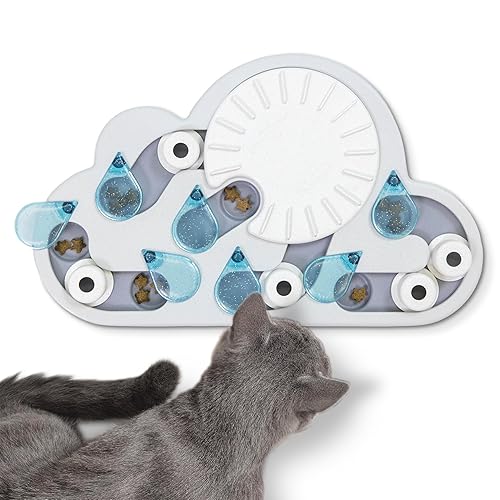
Puzzle feeders are a sneaky good tool: they make the cat work for food, which slows eating, adds activity, and fights boredom all at once. You can start with the world's cheapest version — a few kibbles scattered across a cardboard box — and move up from there. If your cat stress-eats out of boredom, giving the brain a job helps the belly. Even a pot of cat grass gives them something to nibble and investigate that isn't their food bowl.
What NOT to Do (Seriously)
Weight loss in cats has a dark side, and I want to be blunt about it because this is where cats die.
Never starve a fat cat. Fasting or crash dieting an obese cat is the classic trigger for hepatic lipidosis — the liver failure I mentioned earlier. Cornell's Feline Health Center calls it one of the most serious feline diseases, and the most common trigger is exactly this scenario: an overweight cat stops eating, the body mobilizes fat, the liver drowns in it. Even a "simple" thing like a 48-hour hunger strike during a diet transition can tip an obese cat into it. This is why the slow transition matters, and why any loss of appetite longer than a day in an obese cat means a vet call, not a wait-and-see.
Don't feed "light" food without measuring. A weight-management diet does nothing if you free-feed it. The bag says "less calories per cup" — great — but if the cat eats twice as much, you've lost.
Don't cut food by feel. Guessing "a little less" doesn't work. Measure. Weigh. Adjust based on the scale, not your intuition.
Don't ignore medical red flags. Rapid weight loss, weight loss without appetite changes, increased thirst and urination, or a ravenous appetite can all signal hyperthyroidism, diabetes, or other disease. Losing weight is good — losing weight for the wrong reason is not.
When to See the Vet
An annual wellness visit is the baseline — that's when your vet should be scoring body condition and flagging trends. Beyond that, call if your cat stops eating for more than 24 hours (urgent in an overweight cat), loses more than 2% of body weight in a week, or shows thirst, urination, or appetite changes out of nowhere. And if you're starting a weight-loss program, do it with your vet's numbers, not a blog's. The blog can set the strategy; the vet sets the target.
For diet choices during weight loss, our guide to indoor cat food is a good place to start comparing options with your vet's calorie target in hand.
The Bottom Line
Cat obesity is the most preventable health problem in feline medicine, and the fix is boring: measured meals, a slower bowl, more vertical space, and patience measured in months. Your cat will never thank you for it — they'll beg louder for a week and then settle in — but a lean cat at 12 years old still jumping onto the windowsill is the payoff, and it's worth every single complaint.
Start with the vet visit and the first measured meal tonight. That's the whole plan. The rest is just showing up every day.